


Alex with Bliss paper litho,
Marklin, Beggs, etc....
Tinplate Times: Alex, please, tell
us about yourself and your background.
Alex Procyk: I was born in Pittsburgh.
This would explain my streetcar and incline railway fetish. I obtained a B.
S. in Chemistry at Kent state in Ohio and a Ph.D. in Chemistry from Carnegie
Mellon University back in Pittsburgh. I actually finished the last year of my
thesis at the University of California, Riverside and worked in L. A. for about
a year and a half where I met two of my closest friends, through trains of course.
When I started working, I found out my employer had an office for oilfield services
in Houston, and immediately had a bad premonition that I would be transferred
there. I was. California was in a recession at the time and it was nearly impossible
to get a job with my background, so off I went. Goodbye swimming pools, movie
stars. There is a sign in a country store in altogether-more-congenial Gruene
Texas that says “life is too short to live in Houston”. And you
know, there’s something to that. However I must admit that the cost of
living is low and that had contributed greatly to the collection. Also our symphony
is one of the best in the world and I can drive my convertible in the winter
and don’t have to deal with road salt (boy, I remember those times when
you would slam your car door and rust would just fall to the ground. Eeeeeee).
So its not all bad. I am currently an oilfield engineer (so much for the Ph.D.)
for ConocoPhillips.
Tinplate Times: Besides tinplate toy trains, do you have any other collecting interests or favorite hobbies?
Alex Procyk: I was a pretty dedicated mountain biker
(ok, so we don’t have any mountains here; we do what we can) but I hurt
myself repeatedly and badly last summer and have toned it down a bit (I found
the only ravine in Houston and fell down it, twice). I like architecture, 20th
century art, mid-century furniture, and old movie and travel posters. I have
been very slowly transforming my generic 50’s ranch into a weird combination
of Wright-style Usonian house and contemporary inner city loft. Like a lot of
train collectors I had a fling with antique cars (’59 Nash Metropolitan)
but got tired of that tingling feeling in the back of your neck when something
breaks and all you can think about is “how am I going to get back home
and how much is this going to cost?” I haven’t had that experience
with a toy yet. I don’t just collect tinplate trains, I have some boats,
cars, and airships from the usual suspects (Bing, Carette, Lehmann, Markin,
etc). Also my “cheap” hobby is collecting early N gauge from ~1959-1980
and O gauge streetcars. I have also collected a small representation of Pre-1900
toys including paper-on-wood lithographed trains and boats from Bliss and Reed.

Schoenner locomotive,
home made passenger car, Doll lighthouse, Fischer
car
Tinplate Times: Tell us about your toy train affiliations.
Alex Procyk: I am a TCA member and occasionally the
Train Collectors Society (TCS) in England. I am not a clubby guy. If you ask
my friends (all 5 of them) they will tell you I am a pretty antisocial bas-,
er, person (this may explain the science degree).
Tinplate Times: Have you co-authored or acted as a
consultant on and toy train books, articles, web sites, etc.?
Alex Procyk: I wrote an article for Classic Toy Trains
on the evolution of small gauge (H0 and under) trains from the early 000(S)
gauge Schoenner and Carette trains from 1900 to Bing’s table top railroads
to Marklin and Trix’s systems. They paid for the article but never ran
it. Looking back I really should have made it an article about Lionel 00 and
squeezed the other stuff in as an aside to get it published. File it under Life
Lesson #1: know your audience.
I just had an article published in the TCA quarterly on a home made 2”
gauge trolley I had acquired, and a short article in the TCS newsletter feature
called “Desert Island Trains”, in which authors are invited to state
which 5 trains they would most like to take with them if stranded on a desert
island. I have several more ideas for TCQ articles, some actually worth something,
others just “hey look at this” type stuff. I really need to get
around to writing these.
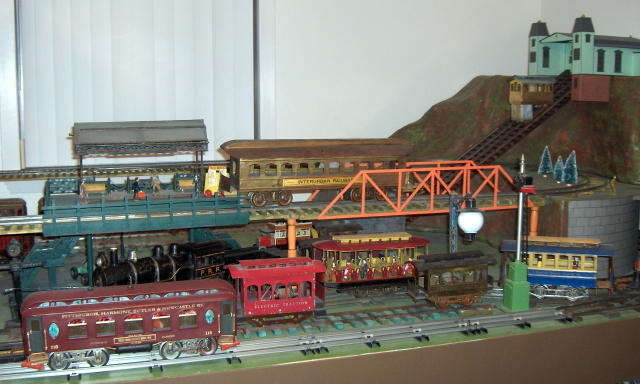
Bottom: home made (by me)
interurban from Lionel 18
coach, home made(someone else) 2" gauge trolley, Lionel 202, Carlisle
and finch 42 trolley, Lionel #1
Elevated: Fandor glass
Dome, Finch interurban
Background: home made (by me) Duquesne (Pittsburgh)
Incline (in progress)
Tinplate Times: What was your first toy train set?
Alex Procyk: Apparently my first set was a 60’s
era Marx windup. Although I still have it, I don’t really remember it
as well as a Lionel turbine freight set my Aunt bought when I was 5.
Tinplate Times: Do you have a layout now? What gauge
interests you the most?
Alex Procyk: I have a combination standard and 2”
gauge-2 rail layout. I made it exactly as one would have around 1910 –
wood, chicken wire and plaster. I turned 11 elevated railway posts on a $60
flea market lathe and never want to do that again. I’ll tell you what,
once you go to 2 rail, you will never want to go back to 3 rail. The 2”
gauge line is hand laid Carlisle and Finch track. Many people have heard my
rant about this track. It looks fantastic, but is painful to put together, and
by the time you are done you understand why Carlisle and Finch lost out to Lionel
and IVES with their glories of sectional track. It was doubly painful for me
because I was using a combination of original Finch ties and George Hopkins
“Trans Attic and United” rails. After nailing in the Finch ties
– 2 nails per tie for good measure - I found out George’s rails
didn’t fit into the finch ties, so I had to hammer – hard - about
30’ of rail into the ties. I didn’t realize that I had original
Finch rails in my coils of George’s rails until after I hammered George’s
rail in. DUH! I also had to redo some curves to get the radius right. Finch
tried to solve this with prefab track, but it was horrible. It was held together
with carpet tacks and falls apart if you look at it wrong. Also for some strange
reason the radius is too tight for the larger locomotives. I borrowed some from
a friend, tried it out, and quickly un-borrowed it. Actually I didn’t
have any large locomotives when I built the layout and never though I would.

L: Carlisle & Finch #34 R: C&F #20
Top: Carette #1 gauge trolleys
As it turned out, I did manage to procure a large Finch Interurban
and #34 locomotive, and discovered that 1) I made the radii too tight for the
interurban and 2) made the clearances around the elevated poles and mountain
too tight for the #34. DUH! Ultimately I gave up on the hand laid track for
the elevated line and made my own 2” gauge track using Lionel rails screwed
to wood ties. This worked fine until I noticed one of the tracks I was cutting
apart with a moto tool was early Lionel split pin. DUH! I had a big 2”
gauge jag going on for awhile but I am not really too interested in getting
much more as the prices are taking the fun right out of it. However one of my
Holy Grails is a Voltamp Interurban. Right now I am becoming fixated on European
3 and 4 gauge. However, if there is anything more expensive than American 2”
gauge, its European 3 and 4 gauge, so I expect this will be an unrequited fixation.
Tinplate Times: Have you always had a layout as an
adult?
Alex Procyk: Always. Even in my horrible 250 sq ft
efficiency during graduate school I made a tiny Z gauge layout under the tree
(said tree was 2’ high). Fortunately I lived about 6 miles from my parents
at the time and built a proper 8x20’ Lionel postwar layout in the basement,
with all the accessories. Between college and graduate school it only took 5
years to build.
Tinplate Times: What tinplate do you enjoy collecting the most?
Alex Procyk: It switches from early American to European,
about on a yearly basis. The folk art quality of the early 2” and Lionel
Mfg. era really appeals to me. It wasn’t meant to look like folk art of
course, they (and here I mean Carlisle and Finch, Knapp, Howard, and Voltamp)
were trying to make the most advanced product that they could. My theory, which
wasn’t built on any research or anything but has a certain “truthiness”
to it, is that they were caught in a situation of relatively low market share
and relatively high production costs compared to the European imports and IVES.
There simply wasn’t market share big enough to tool up for the mass-produced
fit and finish of IVES lithographed and cast iron trains, and there wasn’t
the highly skilled workforce – or at least the ability to pay for one
– to make detailed hand assembled and hand painted trains like those from
Europe. So they evolved a style unique among 2” gauge tinplate; relatively
simple subassemblies that were easy to fabricate and assemble but still captured
the look of the prototype. Details were kept to a minimum. Hand painting was
restricted to simple striping and highlights, and most added decoration was
stamped, stenciled, or transferred onto the cars. Carlisle and Finch increased
surface detail with paper labels, sometimes covering the entire car or engine,
but after 1903 they went with the simpler painted style. However, even though
a lot of it looks like it was knocked up in someone’s garage (and I have
made some original pieces in my garage that look like Finch), when its good
its very good. Voltamp’s quality is amazing. Finch’s 42 trolley
and Voltamp’s Interurban are perfect studies in toy design; they have
excellent proportions and look great from any angle. The same can be said for
Finch’s #34 Atlantic steam locomotive. I actually like it better than
their large #45 locomotive. The #45 is essentially a model of a NYC&HRR
Atlantic. It is very large and elegant, but the #34 is much more toy-like with
stubby proportions and oversized drivers. It is a cartoon of the #45. And if
you think this is easy to do, try to make something original yourself. I have
been working on a Finch-like (brass, paper-labels, and wood) model of Pittsburgh’s
Duquesne Incline for some time now. It is made in 2” gauge but due to
space constraints I had to shrink the head house in proportion to the cars.
In the process, I managed to take out all the appeal of the real building. Somehow
I made a toy that is less toy-like than the real thing! Back to the drawing
board.
Then you have the complete flip of the coin with the European trains. There is nothing folk art about them. Even the early pieces were made in large factories with highly skilled tinsmiths and artists. Early trains from Marklin, Bing and Carette have hand painted details that are astonishing, especially to someone who can’t paint a straight line (me). For example, take a look at the Marklin Grand Central Station in one of my pictures. It is a hand painted building but is so detailed it could be mistaken for a lithographed finish. Speaking of lithography, some of the early lithographed trains from Issmayer, Carette, Schoenner and IVES rival the finest hand painted trains in detail and design, and some of these are my favorites.
Tinplate Times: What trains or sets do you enjoy operating
(running) the most?
Alex Procyk: My two favorite runners are a Pittsburgh,
Harmony, Butler, and Newcastle Interurban I made from a Lionel 18 passenger
car and Pride Lines Motor unit, and a Finch #20 suburban locomotive. The finch
can crawl on D.C. power as well as any modern digital controlled locomotive.
Not bad considering the drive train is basically nailed into a piece of wood.

Beggs Set
Tinplate Times: If you could keep only one toy train from your collection what would it be?
Alex Procyk: They are like your kids, you love them
all. However I would have to choose between two that are pretty irreplaceable.
One is a Beggs 12 wheel Erie car with early Beggs engine that was owned by Walter
Lucas and shown in one of his two historic 1949 articles on Beggs in Railroader
magazine. The engine is clearly Beggs’ first type, but repainted and lettered
for the Erie railway and called the “Jay Gould”. Why someone (presumably
Lucas as he was an Erie fan) would want to honor Jay Gould, a robber baron that
nearly bankrupted the Erie in a stock fraud, I have no idea. In his article
Lucas claimed the car was modeled after Gould’s private railway car. I
have no doubt someone modeled it after his car, but I don’t think it was
Beggs. Close inspection shows almost no similarity to typical Beggs construction.
Regardless, it is a really cool piece.
Maybe the best thing about it was the arc it took to find me. One day I was
looking at the Lucas article, wondering where that car could possibly be now,
even if it still existed, and then a few months later I ran into a guy at York
who was actually selling part of Lucas’s collection. I specifically asked
about that car, but he already sold it to a collector. It turned out that the
collector was a very good friend of mine who was not satisfied with its questionable
originality and was somewhat soured over the fact that it was a bit damaged
in shipping. He had his eye on one of my rarest pieces, which soon became one
of his rarest pieces (an American Miniature Rail Road locomotive, if you must
know), and within 6 months of wondering if the car still existed, I had it on
my shelf.
[I also got to wondering what Jay Gould’s private car looked like. Well,
I didn’t find his ca. 1870 Erie car but I did find his ca. 1890 Ma and
Pa Car, currently sitting next to a hotel in Jefferson Texas, 5 hours up the
street!]
The other choice would be a Schoenner floor toy modeled – very accurately - after the “999”, the fastest engine in its time (and currently residing in Chicago’s Museum of Science and Industry which I totally failed to visit last time I was there). Schoenner is a relatively obscure German company that built mostly steam toys from around 1890-1910, but also made about 6 different floor toy versions of the 999 from approximately O gauge up to a 29” monster. I was talking to noted collector/dealer Pierce Carlson, who had a bunch of the smaller ones scattered around his flat, and mentioned that I wanted the largest one like the type shown in “Century of Model Trains” and “Art of the Tin Toy” (same one pictured in both books). He said “good luck, that’s the only one known of that size”. Bit of a crusher, that. Eventually I came up with a second one (second known to us, at least) out of an auction of American pressed steel toys. However mine is a somewhat simplified version compared to the one in the books and in a different color. It also has a tag pasted under the cab that says it was given to “John Ray Taylor of Arlington for Christmas, 1904”, which I find very interesting as all the books and catalogs state it was made in 1905. This engine was featured in my Christmas card this year, running over Santa’s Sleigh (the hardest part of the set-up was finding a Santa that looked royally ticked off.)
Tinplate Times: What tinplate train or set that you
don't own would you like to have the most?
Alex Procyk: My holy grails are a Voltamp interurban,
Lionel 2 7/8” jail car and 1000 passenger car, but I may actually have
a shot at those someday, somehow, someway. If you are talking about dreaming
for the unobtainable, then it would be a Marklin Paris Metro set, Marklin gauge
III set or even, dare I speak it, a Marklin gauge V set. Let’s just say
this isn’t going to happen without a major change in my career path, and
ConocoPhillips already has a CEO. Oh, there is a train owned by the Russian
government… It was given to the Czar and made by Faberge. It’s a
Faberge egg containing a Z scale sized clockwork train made out of silver (silver
plate?) with jeweled windows. I don’t think I need to worry about that
one either.
Tinplate Times: Are you still adding to your collection?
Alex Procyk: Almost on a weekly basis. Though I really
need to take some time off and turn attention to some other things. Not more
important things, just other things.

Bing 1898-1900 set in front of Marklin hand
painted station
Tinplate Times: Where do you find interesting new trains?
Alex Procyk: Almost all on EBAY and auction houses
as there isn’t a whole lot of early American and European in Texas. We
have a few world-class Lionel collectors here, but not much for sale in my interests.
A $100 Knapp trolley did walk into a local Great American Train meet, but it
didn’t meet me. I had a good run getting obscure early lithographed trains
out of Europe through a friend in England (and I sent him a few in return),
but that had tailed off over the last few years until this Christmas when he
was able to find a Rossignol (French) Steam tram that I have been wanting for
over a decade. Unfortunately it seems to be lost in the post. Maybe it will
show up within the next decade.
Tinplate Times: Do you attend toy train shows? Which
shows do you enjoy the most?
Alex Procyk: I only go to York and the occasional local meets.
York is a hoot and my wife is now hooked. Everybody seems to enjoy seeing her
more than me. Go figure.
Tinplate Times: Do you buy and sell on EBAY? How do
you feel about online trading of toy trains?
Alex Procyk: I both buy and sell on EBAY I have a
love/hate relationship with it. Without EBAY, it would have been very hard for
me to acquire what I have without 1) living in more active areas or 2) having
far more money and free time than I have now. I certainly have used the quick
liquidity aspect of EBAY to raise money. In the cro-magnon days, to sell I would
have had to wait 6 months to take everything to York, or 3 months to post in
the TCA Interchange ad. By contrast, back in Pittsburgh it was typically less
than 2 months between shows with the local TCA and gypsy meets, Greenberg's’s
show and York. And the time in between could be filled with a quick trip across
the state and into Ohio and New York, which includes some of the best toy shows
in the country. Before EBAY I had to have the discipline to save and wait for
the next show. With EBAY, I have a – certainly misplaced – sense
of liquidity that is more fun to play with but in reality isn’t doing
my financial health any good.
The downside to the internet is that the challenge is gone; just wait for what you want to come along, point and click. And just about everything has come along at least once (I loved the guy who put a Lionel 2 7/8” steel gondola on EBAY He had no idea what it was, and when I wrote to him after the bidding was over – in the $5K range and no I didn’t buy it - he said he originally was going to post it with a buy it now of $100!) The only challenge now is figuring out how to afford your winnings and to make sure you aren’t being taken. Believe me, you haven’t lived until you wired a couple thousand dollars you can ill afford to lose to an Argentinean bank account on the basis of a few fuzzy photos and a half decent feedback rating.
A friend of mine told me in the heyday of the Billy Budd meet at York you went
out at 6 AM in the freezing cold (it was colder back then) with a flashlight
to look into people’s trunks as they were unpacking. That’s collecting
I can respect.
Tinplate Times: What is it about tinplate toy trains
that appeals to you the most?
Alex Procyk: The sculptural elements. A friend of
mine collects toys because he can’t afford fine art. I feel the same way,
except I don’t really want to collect fine art beyond maybe a Picasso
or Warhol. I don’t feel any real accomplishment out of acquiring things
with a push of a button, but I get a great deal of satisfaction at just looking
at the damn things once I have them. And like any sculpture, a picture just
doesn’t do it, you need the real thing in front of you. I also like them
because I am fascinated with the machine age, circa 1880-1910. The toys are
contemporary representatives of what existed in real life, and sometimes they
are all that’s left. I would love to collect real trains, trolleys, inclines,
cars and Zeppelins, but there aren’t any Zeppelins left, and if you had
one, where the hell would you put it? One of the things that turns me on is
looking at pictures of the real stuff and seeing how close the toys came to
the real thing. I have a picture of an English train shed Ca. 1910 filled with
GWR stock, and darn if it doesn’t look exactly like Bing’s Sydney
pulling Carette’s GWR coaches. I also discovered a picture of a pre- WWI
torpedo boat that bore surprising resemblance to my Bing torpedo boat.
Have you noticed there aren’t any real torpedo boats anymore? They were
rendered obsolete by “torpedo boat destroyers”, which are now just
called “destroyers”, because there aren’t any torpedo boats
left to destroy. But we still have Bing’s version, which looks a lot like
the real thing and was built at the same time as the real thing. This is the
kind of mixing of history and toys that I really like to study.
Tinplate Times: What do you think will be the future
of tinplate collecting and operating?
Alex Procyk: I am afraid the future looks somewhat
bleak. I am 41, and I know of only 2 people under my age interested in any of
this stuff. And they aren’t interested in paying $20K for a trolley, I
can tell you. A quick look at the demographics suggests that the supply/demand
ratio will be on my side about 10 years from now, which is why I am so careful
(cheap? tight? frugal?) with how much I am willing to spend on any one item.
Having said that, quality always seems to hold value (try buying old Shaker
furniture!) and many have wrongly predicted the demise of the hobby over the
last couple decades. The best stuff will always be sought after, but I think
a lot of people are going to be disappointed at where that “best”
line gets drawn. Do you really see the kids of today lining up 15-20 years from
now to pay top dollar for a Lionel postwar Geep or a 249E freight set? If you
want to see the future of collecting, go to Comicon (comics, sci-fi and fantasy
convention in San Diego). Its like York but bigger and with teenagers. How many
teenagers are at York? These kids will be collecting first generation anime,
pre-steroid era baseball memorabilia and “classic period” snow boards
when they grow up, not trains.
Also people – or at least me - will be even more afraid of fakes then
they are now. As this stuff keeps getting turned over, the provenance will get
murkier while the artistry of the fakers gets better. Its going to be very difficult
to impossible to determine what’s real and what isn’t (already is!).
Pretty soon no one is going to believe anything rare is correct. I simply will
not buy a Lionel 54, 1912 special, 6 special or 7 unless it comes out of an
attic or from a charter member of the TCA who bought it before the repros started
coming out (which was around the late 60’s!). On the other hand, the fine
art world struggles with this constantly, and interest has never been higher.
Let’s face it, collecting is like crack addiction without the tawdry sex.

Bing and Marklin on level 1,
Bing and Flieschmann ships, Carette cars level 2,
Carette trolley and trailer, Marklin 0
gauge set with Rock and Graner mountainside and
Marklin new production
Victoria ocean liner on top.
Tinplate Times: Do you think tinplate collecting and operating will still be around 50 or 100 years from now?
Alex Procyk: 20-30 years out I think the bulk of the
collecting part will be back to what it was in the 50’s-60’s; a
pretty small group of highly dedicated people who will be regarded as “funny”.
You know how you feel about the short wave radio crowd or barbed wire collectors?
Same thing. But 50-100? That would put most items in my collection over 150-200
years old. I expect there would be a lot of renewed reverence for old trains
by then. As I alluded to earlier, the toys are going to largely be the only
remaining tangible, original, and easily storable items from the early industrial
age.
The operators will still be around as long as real trains are around and will
be constantly pushing the technology along. Its only a short matter of time
before operators will be donning virtual reality helmets and placing themselves
in the cab. Of course you can do this right now in virtual space without a layout
at all, but I think there will always be people who need to build something
that takes up space in the house.
Tinplate Times: Do you have any final comments?
Alex Procyk: What is important is
what we do now, with the time we have. And reflecting back, I find it interesting
that the only people I talk to regularly outside work, several times a week,
are friends I met through the trains. I couldn’t tell you where my college
friends are now, I see my family only about twice a year (passing through to
York!) and only get together with my non-collector friends in Houston once every
couple of weeks at best. But my train buddies; we're tight. Now that’s
a powerful hobby!
© 2007 Tinplate Times - All rights reserved.